
PHP2Shell: the patch is only real when the serving process changes
A fixed image in a registry cannot repair a process that is still serving yesterday’s runtime. The October PHP advisory makes deployment identity an urgent part of the incident record.
Published 26 October 2026. Independent news analysis; source announcements are dated in the article.
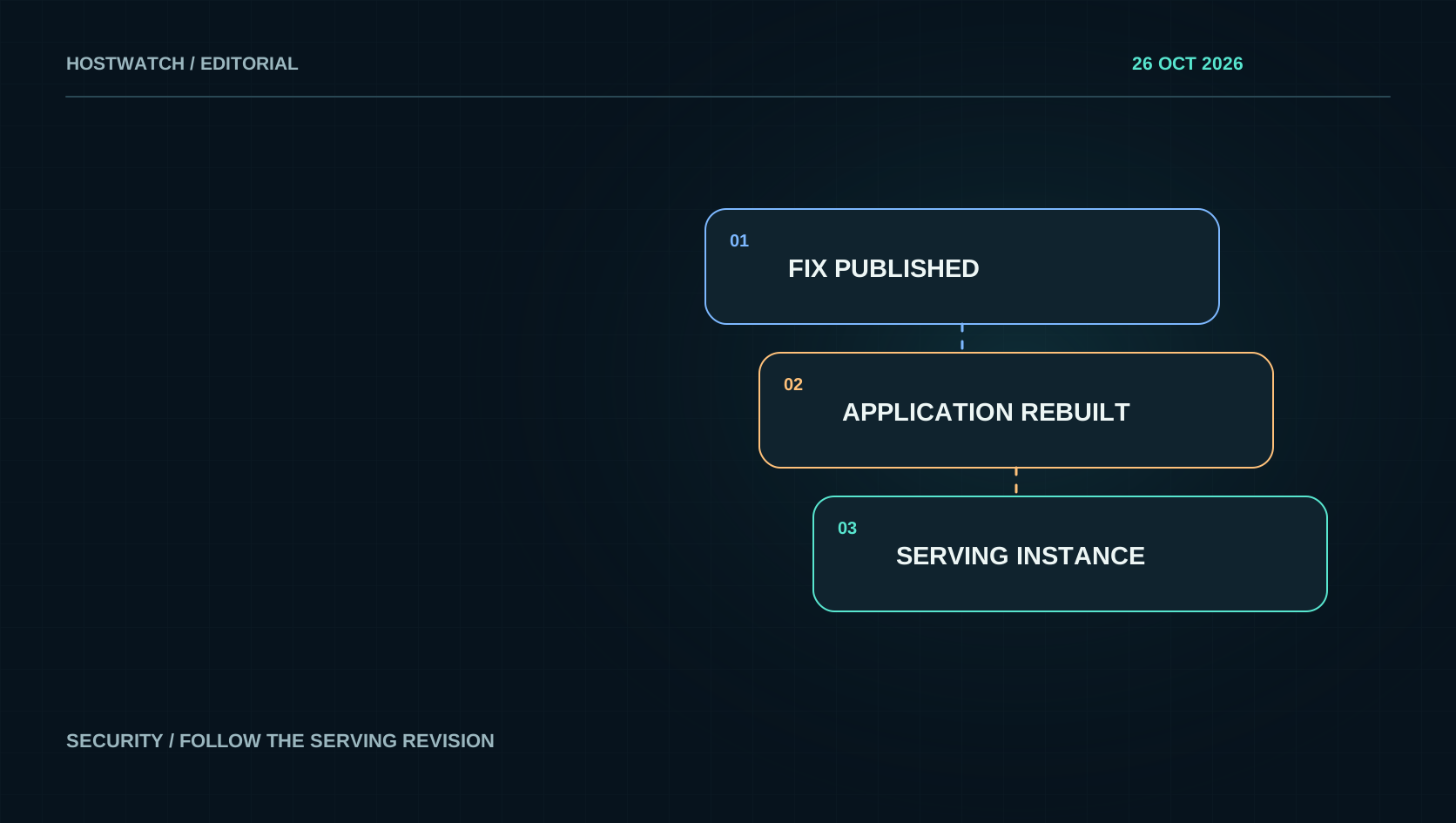
What the October announcements establish
The PHP Foundation’s 21 October announcement identifies two critical engine vulnerabilities, CVE-2026-109618 and CVE-2026-109619, and names the fixed releases: 8.2.35, 8.3.36, 8.4.27 and 8.5.12. Its account describes memory-management and request-error paths that can permit remote code execution under the relevant conditions. Follow the official release guidance for the particular branch and distribution; a version string supplied by an HTTP response is not sufficient evidence about an installed package.
On 22 October, Docker reported updated Official Images and Hardened Images and urged affected customers to update. That establishes upstream availability, not the state of a customer’s running application. The operational analysis below concerns that last gap. It does not claim a Hostwatch PHP exposure scan, observed exploitation in our fleet, or a new automatic patching capability. A useful incident record must connect the vendor’s fix to the application release, the deployed runtime and the route used by customers.
Write down the object you are trying to replace
Imagine a team with a public PHP frontend, a queue worker and a scheduled import. This is an illustrative deployment, not a reported incident. All three may originate from the same repository while using different final images or release schedules. Begin with the executable service boundary: which processes handle public requests, which perform background work, and which image or host package supplies their runtime? Assign each observation to a server and an application role. A repository search that finds one base-image declaration is a starting inventory, not a complete answer.
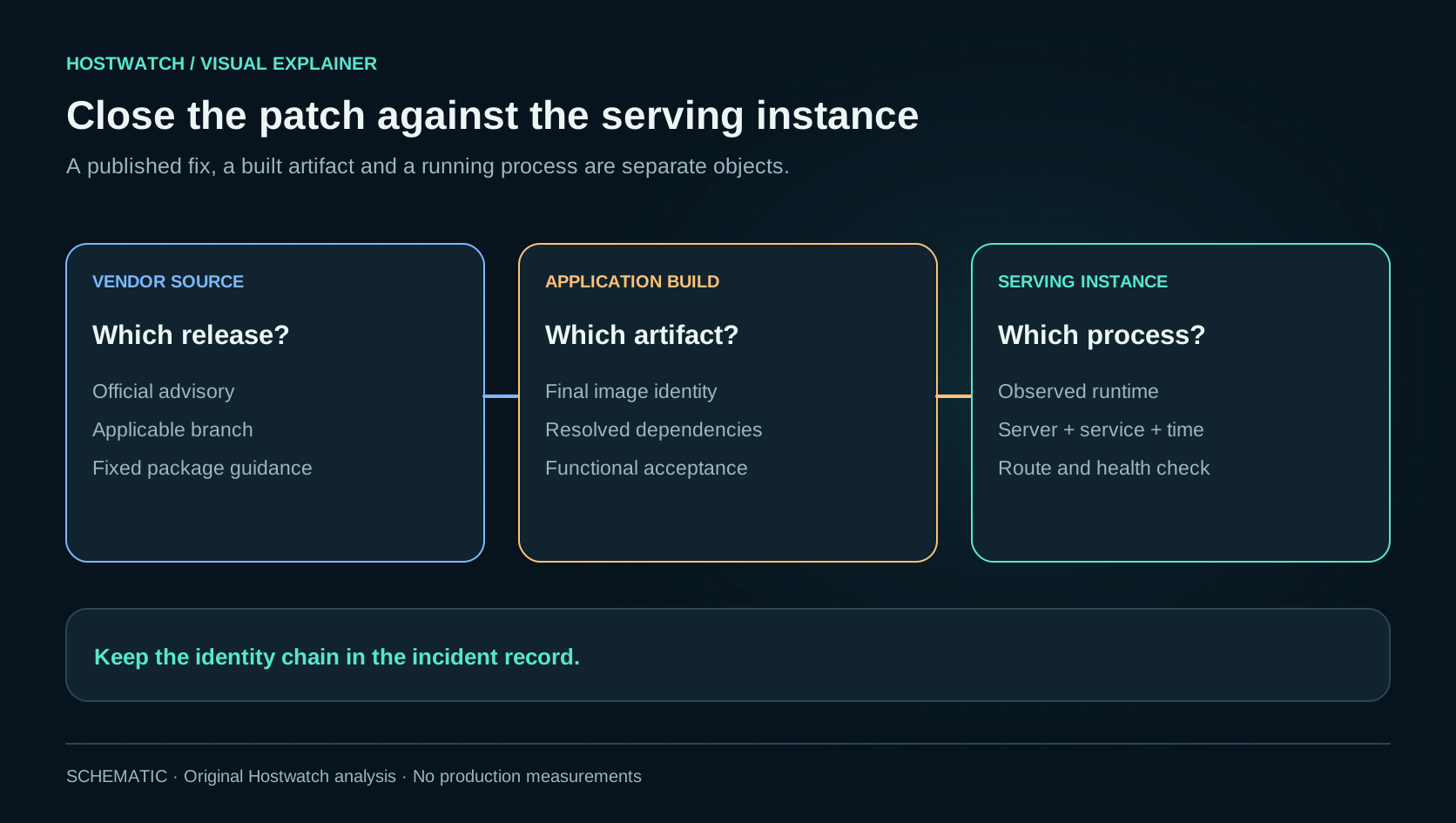
Keep three identities together: the intended application release, the resolved image or package build, and the running process or container instance. Record observation time as well. A tag is a convenient label, but a tag that now resolves to a fixed image does not identify an older container created from it. A digest provides a stronger image reference, while the runtime check confirms which instance uses it. The evidence should let another operator locate the affected service without needing to reproduce the original investigator’s shell session.
Match the inspection to the request handler. A command-line executable found on the host says something about that executable; it does not identify a runtime inside a different container. A maintenance task can likewise run outside the public service’s deployment. Record the context in which a trusted version or package check was performed, including the selected instance and application role. The useful inventory is a short list of serving and background runtimes with a reason for including each one. This is more actionable than a machine-wide search result that mixes active services, old build layers and tools unrelated to the affected application.
Rebuild the application boundary, then inspect the result
For an application assembled from a base image, inspect the final artifact rather than assuming every layer came from the updated input. A multi-stage build can use one runtime during compilation and a different runtime in the final stage. A copied executable or distribution package can have a separate update path. Build logs, lockfiles and provenance help explain how the result was produced; inspecting the final image checks the object you will actually deploy. Keep the verification narrow enough to repeat for each release variant that matters.
Distinguish image replacement from application compatibility. The revised artifact still needs the extensions, configuration, writable mounts and private references required by that service. Use a representative ordinary request, a background task where applicable, and startup diagnostics to check that the application remains functional. These are proposed rollout checks, not a reproduction of either vulnerability. There is no need to send an exploit to a public production endpoint to establish which trusted package or image is installed. Exposure assessment and destructive testing are separate decisions.
Follow the rollout to every serving instance
A deployment command returning successfully may mean that a desired state was accepted. Confirm that the intended replacement instances started and that old serving workers were retired according to the application’s procedure. Include secondary servers, long-lived workers and maintenance processes in the review. Record an exception explicitly if an application cannot move immediately. Otherwise a fleet-level “updated” badge can conceal one old instance behind a healthy load balancer, and an operator sampling only the primary server may never see it.
A bounded rollout should name the first instance, its health checks, the decision to continue and the conditions for stopping. Compare request completion, latency and upstream failures over a stated interval, without interpreting normal traffic variation as a benchmark. If the application becomes unhealthy, retain the failed rollout’s identity and investigate compatibility rather than quietly removing the evidence. A rollback may restore service while reintroducing an affected runtime; that tradeoff requires its own recorded decision and follow-up. “Back online” and “remediated” answer different questions.
Keep containment and patch evidence in separate lanes
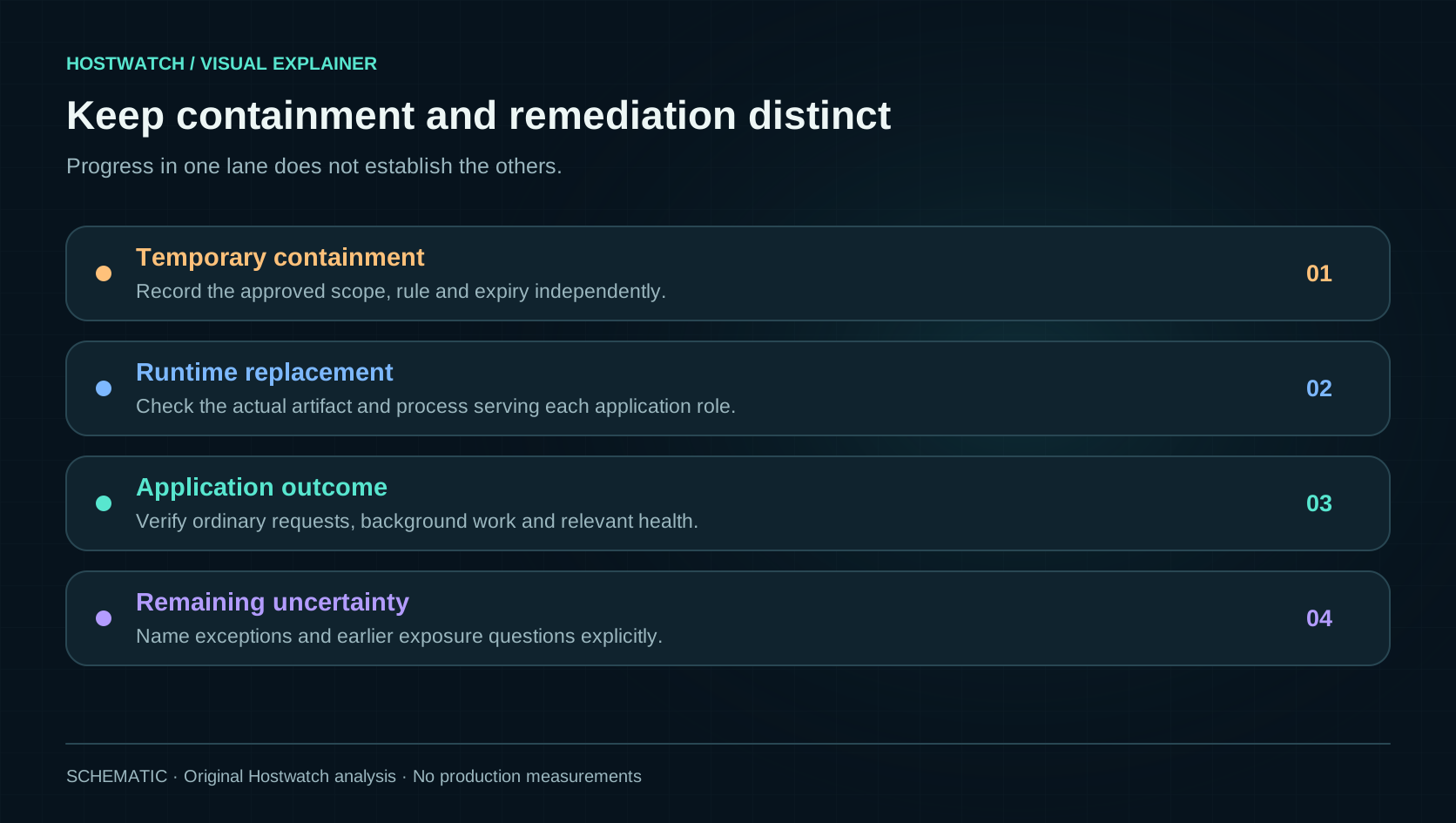
During a security update, teams may temporarily reduce exposed functionality, restrict an administrative route or use an approved edge control. Record the scope and lifetime of those decisions independently from the runtime replacement. A fall in rejected traffic can result from a rule, a client giving up or a changed observation window. It cannot prove that a vulnerable process was replaced. Equally, a successfully replaced runtime does not prove that an earlier suspicious request never had an effect. Avoid compressing these distinct investigations into one protection score.
For a monitoring interface, the useful pairing is a deployment timeline beside application outcomes. Show the revision change, the serving instance and the observation time, then the corresponding health and traffic evidence. Keep policy limits, confirmed mitigation and ordinary failures distinguishable. Where runtime identity was not collected, leave the status unresolved and ask for a direct inspection. Hostwatch can organize observed service facts and response evidence, but this article does not claim that its inventory automatically certifies PHP patch status or substitutes for the vendor’s remediation guidance.
Leave a handoff that survives the next deployment
The final record should say which service and route were checked, which fixed release guidance was used, which artifact was deployed, and which instance was observed serving afterward. Include the time, the functional result and any exceptions. Preserve safe identifiers and release references, not environment dumps or customer payloads. A later deployment can change the answer, so the record describes a verified moment rather than permanent immunity. The next release should repeat the relevant identity check as part of its ordinary acceptance process. Include a named owner for every exception and its next review time.
This makes the response useful beyond one advisory. The team learns whether its inventory includes background runtimes, whether final artifacts can be traced to maintained inputs, and whether the operator can distinguish accepted deployment requests from completed replacements. Those are concrete improvements to the deployment process, even on a small server. The practical endpoint is an explainable chain from a published fix to a functioning serving process, with remaining uncertainty stated clearly enough that the next person knows what still requires attention.
Close a patch rollout against the runtime actually serving each route. Preserve the image and process identity, the observed version and a functional check; traffic limits alone cannot establish remediation.