
Docker’s CA update exposes a familiar gap: patched tools, stale environments
A security fix can reach the image registry while an existing agent environment keeps its old trust. Docker’s October advisory is a concrete reminder to track the runtime, not just the updater.
Published 23 October 2026. Independent news analysis; source announcements are dated in the article.
The advisory concerns the trust inside the sandbox
Docker’s security guidance, updated on 21 October, says its built-in sandbox templates were rebuilt with updated CA certificates after the eMudhra intermediate-CA key compromise disclosed on 20 October. It explicitly warns that updating the sbx CLI does not update existing sandboxes. The documented paths are to recreate environments from freshly pulled templates or update CA certificates inside an existing sandbox, then restart applications as needed. Software with its own CA bundle may need separate attention. See the vendor advisory for current instructions and affected context.
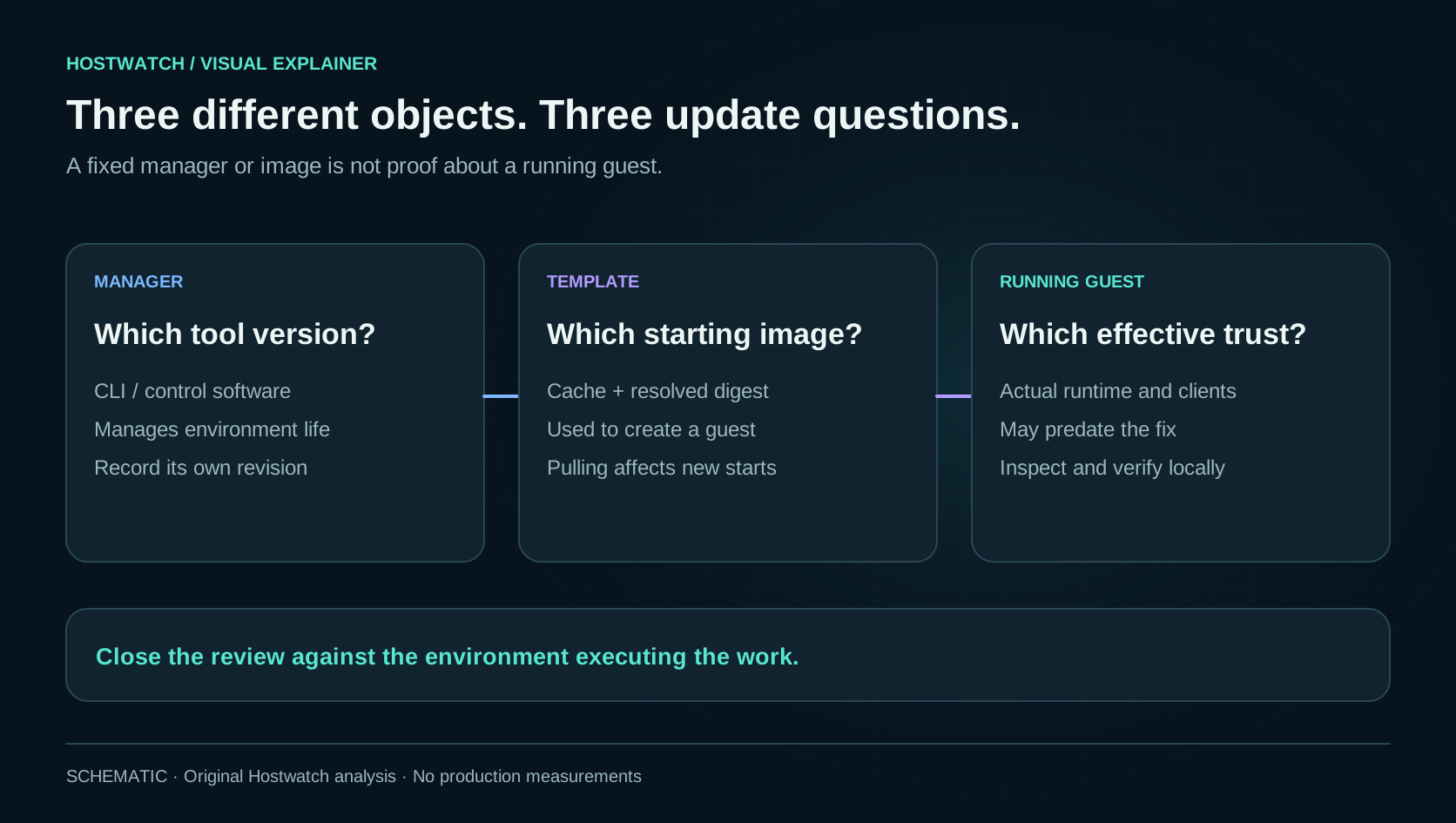
Our analysis focuses on the lifecycle gap behind that advice. A sandbox manager, a template cache and a running guest are different objects with different histories. An update to one does not establish the state of the others. That distinction matters for coding agents because their environment can remain alive across many tasks, pulling dependencies and calling external services long after its initial creation. Isolation constrains the environment’s reach, but operators also need evidence about the trust and software state within the environment that is doing the work.
Inventory the environment that is actually running
Start with an inventory small enough to act on. For each relevant sandbox, record its name or stable ID, creation time, template identity, current state, owner and the work that must survive replacement. Track the manager’s version separately. If an image tag is mutable, retain the resolved digest when available. The questions are practical: which environments were created before the change, which have been updated in place and which have been verified afterward? A list containing only the newest template version cannot answer any of those questions for an existing guest.
Also distinguish a local environment from a cloud environment. Docker documents separate credentials, network policies and lifecycle controls for those modes in its Sandboxes overview. Our recommendation is to keep the mode in every update record so an operator does not apply the assumptions of a local workstation to a remote environment. Record the environment’s actual access grants and useful data, without exporting its secrets. A running guest with a familiar name is not proof that it has the same mounts, work tree or credential arrangement as the one you inspected yesterday.
Choose replacement or repair after preserving the work
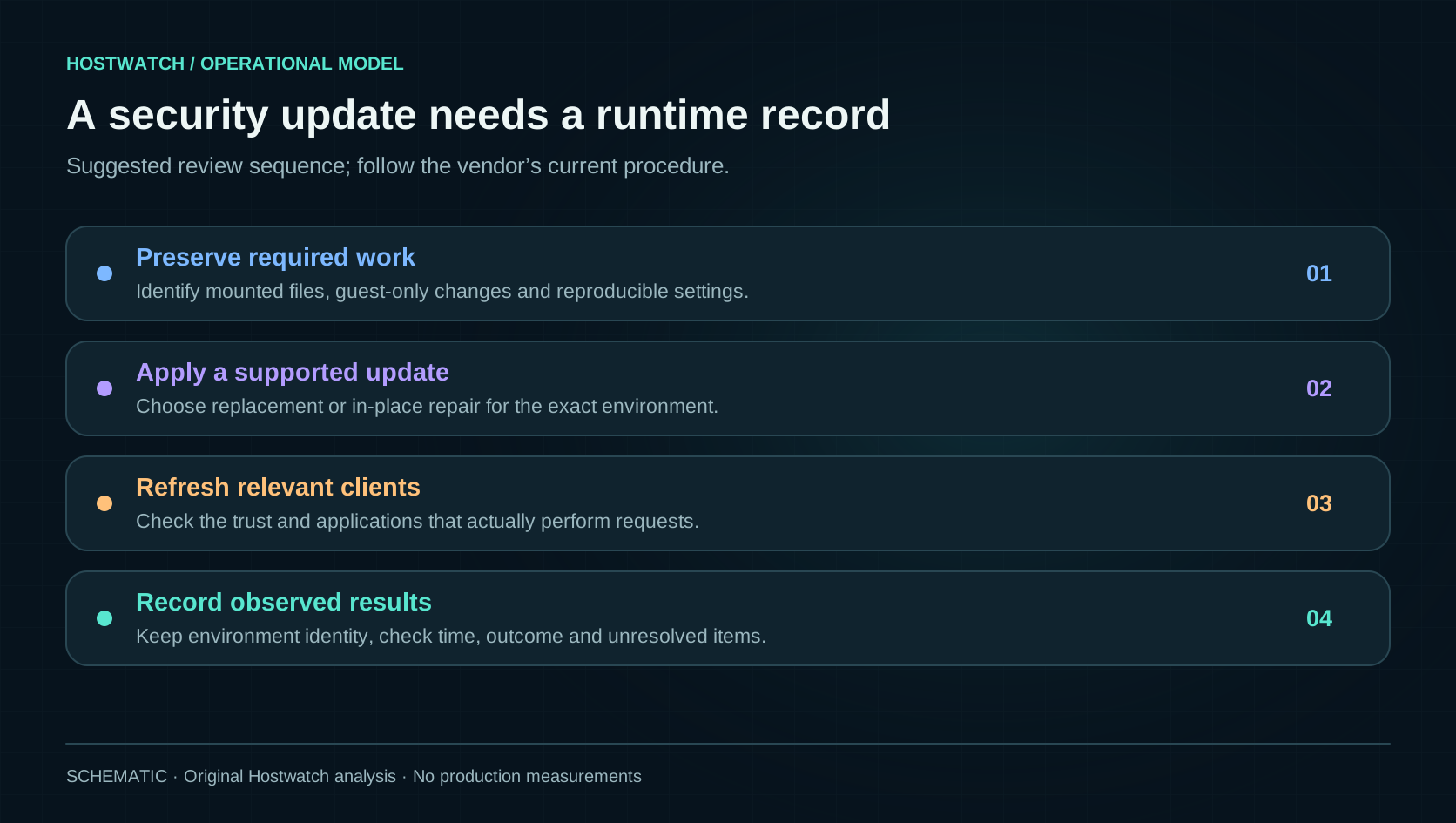
Before replacing a working environment, identify what is durable. Check whether edits live in a mounted workspace, a cloned repository inside the guest or a directory that will disappear with the environment. Preserve unpushed commits, generated artifacts that cannot be reproduced and the configuration needed to recreate approved access. Do not assume that every file the agent can see is on the host. The preservation step should be explicit and bounded; copying an entire guest into an uncontrolled archive can unnecessarily duplicate credentials and unrelated files.
Then choose one documented update path and record why. Replacement gives a clearer starting image but requires rebuilding the working context. Repair in place may preserve a complex session but needs evidence that the relevant trust and applications were actually refreshed. These are engineering tradeoffs, not a reason to invent a universal “recreate everything” button. For a managed fleet, group environments by owner and maintenance constraints. Try the procedure on a disposable representative instance, verify the workspace survives and confirm the new instance uses the intended policy before applying the same process more broadly.
Verify the clients that make network requests
A trust-store change should be checked at the point where requests occur. Identify the package manager, language runtime, Git client, model client and any application that supplies its own networking stack. The relevant question is not merely whether a package installation command returned zero; it is whether the intended client is using the updated trust material in the environment where the task runs. Keep the check aligned with vendor instructions and avoid ad hoc certificate changes whose effect cannot be explained. Never make a failing verification appear fixed by disabling certificate validation.
For ongoing operations, maintain a short verification record: environment identity, update method, client restarted or recreated, check time and result. Use safe diagnostic output and redact credentials from URLs and headers. A successful connection to a normal endpoint establishes only that particular connection; it is not a comprehensive proof about the full trust store. Combine runtime inspection with the upstream update guidance. If a client’s bundle or version cannot be established, leave that item unresolved. An honest partial result is more useful than a fleet-wide green badge inferred from one guest.
Make automation specific to an environment and an action
An infrastructure tool can help by joining inventory, ownership and update state, but it should not infer permission to delete an environment from the existence of an advisory. A reviewable action identifies the exact sandbox, the preservation plan, the expected replacement and the health check. If the task affects an active agent session, show that consequence before execution. Keep a durable operation ID so a lost connection does not turn one replacement into several. When the result is unknown, inspect the environment before retrying with a new action.
This also helps prevent a misleading security score. An environment can be isolated, running an old template and still awaiting an update at the same time. Those are independent facts. Show them as independent facts rather than collapsing everything into “secure” or “insecure.” Where policy is centrally managed, retain the effective policy revision alongside the environment identity. Where updates are manual, record the responsible owner and next verification step. Useful automation reduces the number of unanswered questions; it does not hide them behind a completed maintenance job.
Close the loop at the runtime, then reduce future drift
A complete review ends with the running environment, not the package manager. Confirm that the intended sandbox is reachable, expected work is present, approved network rules still apply and the relevant clients have been refreshed. Retire obsolete copies deliberately so a scheduled task cannot quietly return to a stale environment. Keep the recovery path narrow: preserve work and reproducible settings without treating an old trust state as an indefinitely acceptable rollback target. If the maintenance exposed an undocumented dependency, add that dependency to the next inventory.
The larger lesson is about drift. Long-lived agent environments are convenient precisely because they accumulate useful state; that also makes them easy to miss when a security fix lands upstream. Give them an owner, a visible age and an update path. Establish a periodic check for discrepancies between the desired template and the guest actually executing tasks. This does not require rebuilding every environment on every patch. It requires being able to answer, with evidence, which runtime changed, which did not and which verification remains. That is the difference between distributing a fix and knowing it reached the work.
Close a sandbox security update only after the affected running environment and its actual clients have been checked. An updated CLI or newly pulled template is intermediate evidence.